
CLEARANCE PRICING — FREE CUTLERY SET + CARRY BAG WITH EVERY BOXOffer ends in--:--:--

Gift guide

9 Gifts for the Man Who Says He Doesn't Need Anything

He'll spend four hundred dollars on a tool without blinking and won't spend forty on himself. Nine things he'd never buy, and will use every single day.

Skip to the one most people buy

The list

Nine things he won't buy for himself

The problem isn't that he's hard to buy for. It's that he has decided he doesn't need anything, which is a different problem entirely. Everything here is something he uses daily, wears out quietly, and replaces about four years later than he should.

Wool socks that aren't the ones with holes in them

He has three pairs. Two of them are finished.

Check his sock drawer. There'll be a rotation of the same few pairs, thinning at the heel, and he'll wear them until they're transparent, because buying socks for himself feels like a waste of money.

Merino wool is the upgrade he'd never make on his own. It holds its shape, it doesn't hold smell the way cotton does, and it stays warm even after his boots have leaked. About $25 a pair. Buy him five pairs and he'll mention it to you six months later, which from him counts as effusive praise.

A hot lunch, with no microwave anywhere in sight

The one on this list that changes his whole day.

Ask him what he had for lunch. He'll say he ate. What that usually means is a cold sandwich in the front of the truck, or eighteen dollars at the gas station on something he didn't really want.

It isn't stubbornness. There is genuinely nowhere to heat food on most job sites. No outlet on a framing job, no microwave in a day cab, and where there is a break room, the microwave has somebody else's chili baked onto the roof of it.

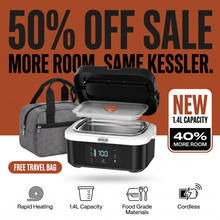
A cordless heated lunchbox fixes it properly. It runs off its own internal battery, so there's no cord, no outlet, and no need to sit with the truck running. He puts last night's dinner in it in the morning, presses the button around eleven, and eats something hot at noon. It heats gently, more like a small oven than a microwave, so the meat doesn't turn rubbery and the rice doesn't dry out.

The liner is 304 stainless steel, so his hot food never sits against plastic. Kessler is $108.99, and it pays for itself in about six lunches he doesn't buy.

"He told me not to spend the money on him. He's used it every day since May."

Safety glasses he can actually read through

The tape measure didn't get smaller.

Watch him read a mark. He pushes his safety glasses up onto his forehead, squints at it, then pulls them back down. That gap — glasses off, eyes exposed — is when things go wrong.

Bifocal safety glasses carry a magnified reading segment at the bottom of the lens and stay clear at the top, so he keeps them on all day instead. Look for an ANSI Z87.1 rating in the US, or CSA Z94.3 in Canada. Around $30 a pair. Get him three: one for the truck, one for the bag, one he'll lose by March.

A headlamp that charges instead of eating batteries

It's dark at half four in December and he's still working.

He owns a flashlight. He holds it in his teeth. This is a solved problem, and he hasn't solved it purely because it never quite makes it onto a list.

A rechargeable headlamp with a decent beam and a red night mode means both hands free in a crawlspace, an attic, a panel box, or the back of a truck at five in the morning. Get one that charges over USB-C so it uses the same cable as everything else he owns. Around $30 to $50.

Ear muffs he'll actually keep on

He's already lost some. This is about protecting the rest.

You've noticed him turning the television up. He's noticed too, and he won't mention it.

Standard hearing protection blocks everything, so he pulls it off every time somebody speaks to him — which is exactly when the damage lands. Electronic muffs amplify ordinary speech and clamp down on the loud stuff in milliseconds, so he can hold a conversation without taking them off at all. Around $50 to $80.

Noise-induced hearing loss doesn't come back. And what he'll miss isn't the job site. It's a grandchild talking quietly across a noisy room.

Winter gloves that still let him hold a screw

His current pair is either too thin or useless.

Most men in the trades own two kinds of gloves: thin ones that let them work but leave their hands numb by nine, and thick ones that keep hands warm but make anything fiddly impossible. So they wear the thin ones and put up with it all winter.

Insulated gloves with a textured palm and enough dexterity to pick up a screw remove the false choice. Look for a touchscreen fingertip so he isn't peeling one off every time his phone rings. Around $35 to $50.

Insoles for the knees, not the feet

Concrete doesn't give. He does.

The insole that came in his boots is a thin sheet of foam and it went flat two years ago. He hasn't replaced it, mostly because it hasn't occurred to him that it's replaceable.

A semi-rigid orthotic insole spreads load across the whole foot instead of letting it hammer through the heel. Most men notice the difference in their knees and lower back well before they notice it in their feet. $40 to $60, and a good pair outlasts two sets of boots. Check his boot size before you order.

A real first-aid kit for the truck

Right now it's a roll of tape and optimism.

Ask him what he'd do about a deep cut on site. He'll tell you he'd wrap it. That is the entire plan.

A proper vehicle kit — pressure bandages, a tourniquet, eye wash, burn gel, tweezers that actually grip — lives under the seat and costs about $40. He will never buy one himself, he'll roll his eyes when he opens it, and he'll be quietly glad it's there the first time someone on his crew needs it.

A flask that's still hot at two in the afternoon

Because the coffee shouldn't be cold either.

The one he carries now is a gas-station special with a tired seal, and the coffee in it is lukewarm by nine.

A proper double-walled vacuum flask holds heat for most of a working day. Around $45 for one that will outlive the truck. Put it alongside number two and the picture is complete: a hot coffee at six in the morning, a hot meal at noon, and a man who finally stops telling you he doesn't need anything.

If you're comparing

Cordless vs. the $30 ones

There are cheaper heated lunchboxes. This is what separates one he'll use every day from one that ends up on a shelf in the garage.

Feature Kessler $30 generics
Heats off its own battery — no cord, no outlet Yes Needs a 12V socket
304 stainless liner — hot food never touches plastic Yes Usually plastic
Works without the vehicle running Yes No
Sealed, leak-proof lid Yes Varies
Cutlery set + carry bag included ($19.98 value) Yes No
$18
Typical spend on a bought lunch, per day
304
Grade stainless liner — no plastic contact
0
Cords, outlets or microwaves required
Most gifted
The one from #2

Kessler HotBox™

Cordless heated lunchbox. 304 stainless liner. Charges like a phone, heats anywhere.

Buy 2, save 15% — $185.28 for the pair

$108.99 · free cutlery set + carry bag included ($19.98 value)

See it
  • Free cutlery set + carry bag with every box
  • Cordless — no outlet, no cord, no microwave
  • 304 stainless liner — hot food never touches plastic